

🔎 Project information
- Project name: Light Explorers
- Service: Winyu Early Childhood Service, Gungahlin
- Award: ACT Winner of the Excellence in Early STEM Education Awards 2024
- Frequency: Daily for 3 months
- Number of children: 42
- Age of children: 3-6 years
💥 Project Summary
During a brainstorming session about winter solstice in Canberra, the children noticed that it was becoming dark earlier. This prompted the children to ask “Why does it get dark earlier in winter?” This sparked three-months-long inquiry-based project, in which the children explored the concept of light, including how light interacts with objects, how it can create different colours, where it comes from, and how it affects their daily lives.
💡 Collecting Ideas
The children already had a basic understanding of light, primarily through their observations of how sunlight changes during winter time and noticing their own shadows. They recognised that natural light comes from the sun, but they had many questions about how light actually works. When discussing why it gets dark earlier during winter times, children expressed various hypotheses: One child suggested “Maybe the sun goes to sleep earlier because it’s colder outside”, while another proposed “Maybe because it was cloudy, it gets dark faster.” Another said it gets dark earlier because “the sun gets ice cold, not hot, at night.” These hypotheses reflected their attempts to make sense of their observations and connect them to their existing knowledge about light.
🧪 Experimenting
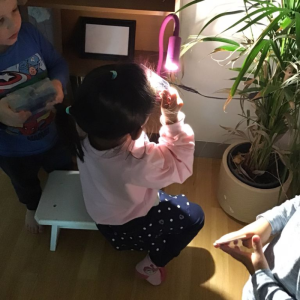
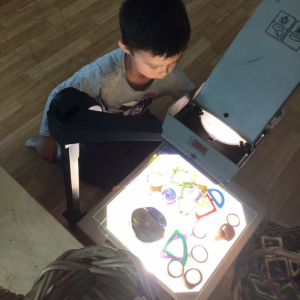
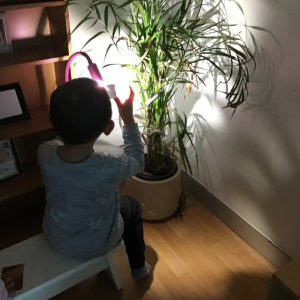
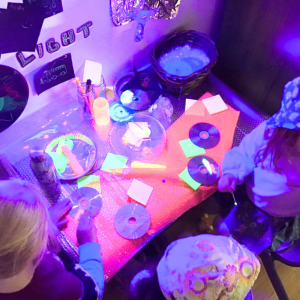
To answer their questions, the children utilised everyday materials around the service to explore light, including flashlights, mirrors, prisms, coloured filters, and natural light sources like the sun. They took the lead in setting up the exploration areas, arranging materials, and creating displays to showcase their discoveries.
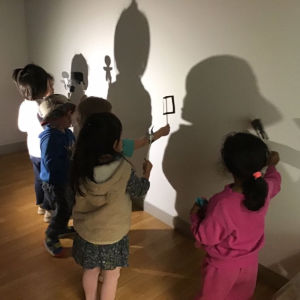
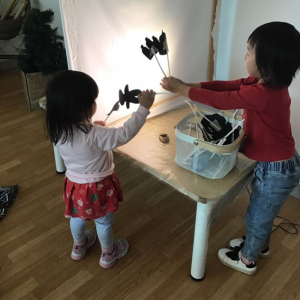
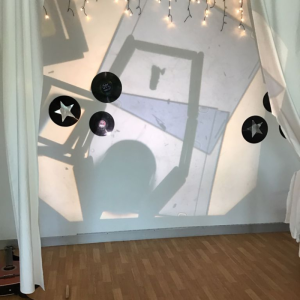
The children placed human-shaped pieces of paper in front of a torch and then observed how the shadows change size and shape depending on the distance from the light source. While experimenting with shadows, a child wondered aloud, “Where is my shadow?”, which sparked a discussion about how light travels and interacts with different objects, such as the human body. The children also explored the concept of reflections and how they might change depending on the type of mirror used and whether a surface is shiny or opaque.
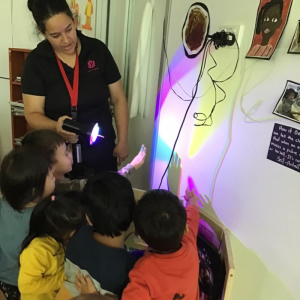
The children also noticed how colours blend and separate when passing through prisms and filters placed on top of torch lights. One child exclaimed, “Look! Rainbow colours!” This observation led to further experimentation with colour combinations and discussing what might result from mixing primary and secondary colour filters.
By encouraging these inquiries and providing space for exploration, the children were able to actively construct their understanding of light and its characteristics.

ACT Winner: Excellence in Early STEM Education Awards 2024

This project was the 2024 ACT Winner of the Excellence in Early STEM Education Award as part of the Little Scientists Early STEM Education Awards. These biennial awards call upon early learning services and classrooms to nominate by submitting an inquiry-based STEM project co-developed with their children 0-8 years. Projects were judged on originality, STEM content, alignment to the inquiry cycle, child-led approach, and use of a gender lens.